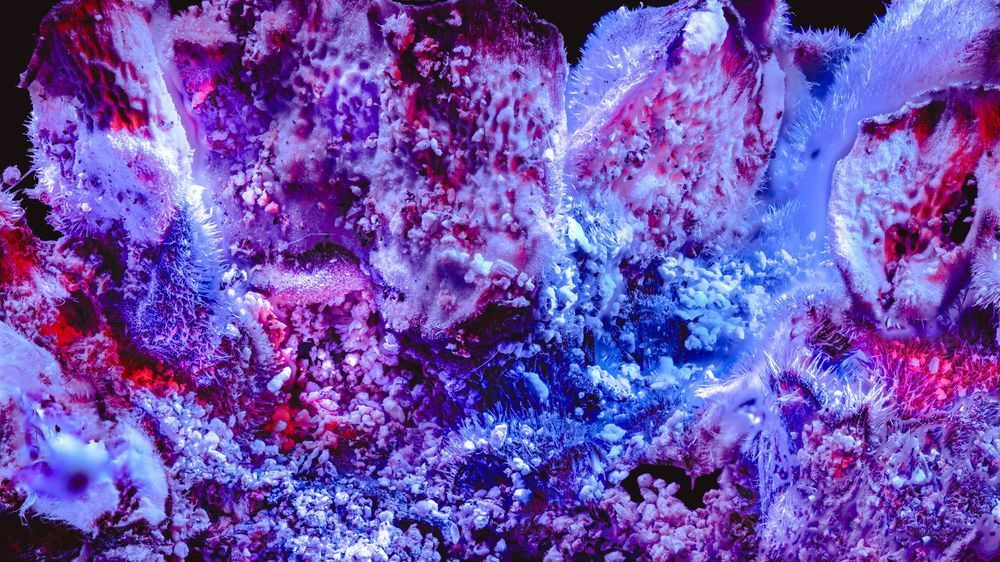
Magic Land explores the extraordinary structural complexity of turkey tail fungus (Trametes versicolor), transforming its intricate surfaces into an immersive landscape of sculptural formations, delicate textures, and luminous color. Through extreme macro photography, the familiar woodland fungus becomes an unfamiliar environment reminiscent of an alien landscape or a fantastical world existing far beyond ordinary human perception.
The composition is dominated by irregular, vertically oriented fungal structures that rise above a densely textured surface. Their complex contours create the appearance of towering formations, miniature cliffs, and intricate natural architecture. Some structures display broad, uneven surfaces marked by countless small depressions and granular details, while others reveal delicate, hair-like projections extending along their edges.
Electric blue and violet illumination reveals the remarkable complexity of these surfaces, while vivid magenta and crimson highlights introduce dramatic contrasts throughout the photograph. The interplay of cool and warm colors creates an extraordinary sense of depth, separating individual formations and revealing the intricate relationships between overlapping fungal structures.
Near the center of the composition, a broad, irregular formation rises above a dense collection of smaller textures. Its surface appears almost geological, marked by ridges, cavities, and clusters of tiny protrusions. To the right, pale blue structures emerge from deeper within the scene, their delicate edges catching the light and creating the impression of translucent, crystalline formations.
Across the lower portion of the photograph, countless small granular structures form an intricate landscape of uneven surfaces and miniature projections. These details establish a visual foundation beneath the larger formations, reinforcing the impression of an expansive environment despite the photograph’s extremely small physical scale.
One of the most distinctive characteristics of Magic Land is its ambiguity of scale. Without the familiar context of a mushroom growing on decaying wood, the viewer encounters a landscape that appears almost monumental. The irregular formations resemble cliffs, caves, and unfamiliar geological structures, while the delicate surface textures suggest crystalline deposits or exotic vegetation.
Carefully controlled colored illumination intensifies this transformation. Electric blue emphasizes the delicate contours and granular details, while violet and magenta create atmospheric transitions between the overlapping structures. Deep shadows introduce pockets of mystery, suggesting hidden spaces extending beyond the visible composition.
The title, Magic Land, reflects the photograph’s extraordinary sense of discovery. What begins as a close examination of a common woodland fungus becomes an exploration of an unfamiliar world filled with unexpected structures, luminous textures, and imaginative possibilities.
Unlike traditional mushroom photography, which typically emphasizes the recognizable shape and natural habitat of the organism, Magic Land concentrates entirely on the intricate details of its physical structure. The familiar identity of turkey tail fungus disappears beneath magnification, allowing the photograph to function as an independent abstract landscape.
The image demonstrates how extreme macro photography can transform overlooked natural subjects into visually expansive environments. Its intricate formations and dramatic color relationships invite viewers to reconsider the scale and complexity of the biological world, revealing extraordinary beauty in structures that ordinarily remain unnoticed.
Magic Land celebrates the intersection of natural complexity, imaginative interpretation, and contemporary fine art photography. It reveals how a small fragment of woodland fungus can become an immersive landscape of mystery, texture, and light, transforming the familiar into something genuinely extraordinary.